Classroom activities
Key Stage 1&2:
Art and Design
Investigating Materials (Unit 1b)
Can Buildings Speak (Unit 2c)
Investigating Pattern (Unit 3b)
Investigating Materials (Unit 1b)
Can Buildings Speak (Unit 2c)
Investigating Pattern (Unit 3b)
Citizenship
Living in a Diverse World
(Unit 5)
Key Stage 3:
Art and Design
What's in a building? (Unit 7b)
Change your style (Unit 9b)
Citizenship
Britain – a diverse society?
(Unit 4)
History
What were the achievements of the Islamic State 600-1600? (Unit 6, section 5)
Leighton House Webquest (download Word document)
Pattern Log(download Word document)
Materials Log(download Word document)
Key Stage 1&2 Art and Design:
classroom activities
All the activities below cover all areas of KS1/2 programmes of study for Art
and Design and can be taught with a strong ICT focus. They of course all link
with the scheme of work 'Visiting a Museum, Gallery or Site' (Unit 9gen)
Suggestions for cross-curricular work and class projects
Investigating materials (Unit 1B)
Can buildings speak? (Unit 2C)
Investigating pattern (Unit 3B)
Suggestions for cross-curricular
work and class projects
These Art and Design activities can easily be extended to create
cross-curricular projects. You could do so by including one or more of the
following:'Can buildings speak' activity below:ask pupils to pretend to be Leighton and write a letter home to his mother from Cairo, or a diary entry, describing an outing in the city and a visit to the Pyramids. Use the articles on the website for background information as preparation. Links with KS1 and KS2 English (En1, 2 and 3), History and Geography.
Ask pupils to write a poem about dancing figures. What are they doing? Wearing? Thinking? Feeling? Listening to? Pupils can use their imagination as freely as they like. Links with KS1&2 English (En3)
Ask pupils to write a story taking inspiration from the figures in the mosaic Links with KS1&2 English (En3)
Pupils do a project on Leighton, researching aspects of his life, house, travels and painting using the website. They present information to the class and create a classroom display. Be sure to encourage pupils to use the 'Paintings and Drawings' section of the website. Links with En1, 2 and 3, ICT, History, Geography and RE
Learning about Islamic art and architecture (see What is Islamic Art? article) ties in with RE The Qur'anic calligraphy tile panel, and hanging lamp tile panel can be used as visual material for this. Links with KS2 RE, Unit 5A 'Why is Muhammad important to Muslims' and Unit 5B 'How do Muslims express their beliefs through practices'?
Links with English (En1, 2), Maths (Ma3) and Design and Technology
'Investigating Pattern' activity below:
Links with Maths, Design and Technology (Unit 4A 'Money Containers') and ICT Unit 4B 'Developing images using repeat patterns'
Investigating Materials' activity below: Builds on Science 'Sorting and using materials' (Unit 1c)
Investigating materials (Unit 1B)
Leighton House incorporates many materials in its construction and interior decoration. Pupils use either a visit to Leighton House Museum, or a handling collection inspired by Leighton House Museum as a starting point for investigating how different materials are part of our everyday life and have been used by different artists and cultures over time to decorate homes.Aim:
For pupils to think about the
materials they encounter in their daily life and why they might have been used.
For understanding the
relationship between materials and function.
To create a weaving either for
use as a tablemat, or wall decoration using either manmade and/or natural
materials.Method:
Resources:
Leighton and Middle East website:
Virtual Tour of Leighton House
Website of the following institutions may also be useful for research and images:
The Victoria and Albert Museum, London
The British Museum, London
Canadian textile museum
Materials:
handling collection corresponding approximately to materials used in construction and decoration of house: brick, wood, tile, woven carpet, piece of silk, glass (wallpaper in the 'Silk Room' upstairs at Leighton House), also selection of artefacts showing how materials are used in different ways i.e. knitting, different wooden items. Materials log. For practical work natural (twigs, rushes, leaves) and man-made materials (straws, strips of fabric, string), scissors, dyes, paints, looms (card with notches, spokes of a wheel, large picture frame, sticks or boxes).
Activities:
1) Visit the museum or go take pupils on a virtual tour as a class.2) Pupils complete the materials log (provided on website).
3) Class discussion about why different materials are used.
4) Class discussion about how textiles are used in different cultures (use websites for research and information and with pupils).
5) Each child selects materials (thinking about colour, strength, texture, effect) and frame for their weaving.
6) Weaving activity.
7) Provide opportunity for pupils to show and talk about their weaving and why they chose that materials.
Cross curricular links:
Science 'Sorting and using materials (Unit 1c)
Can Buildings Speak (Unit 2c)
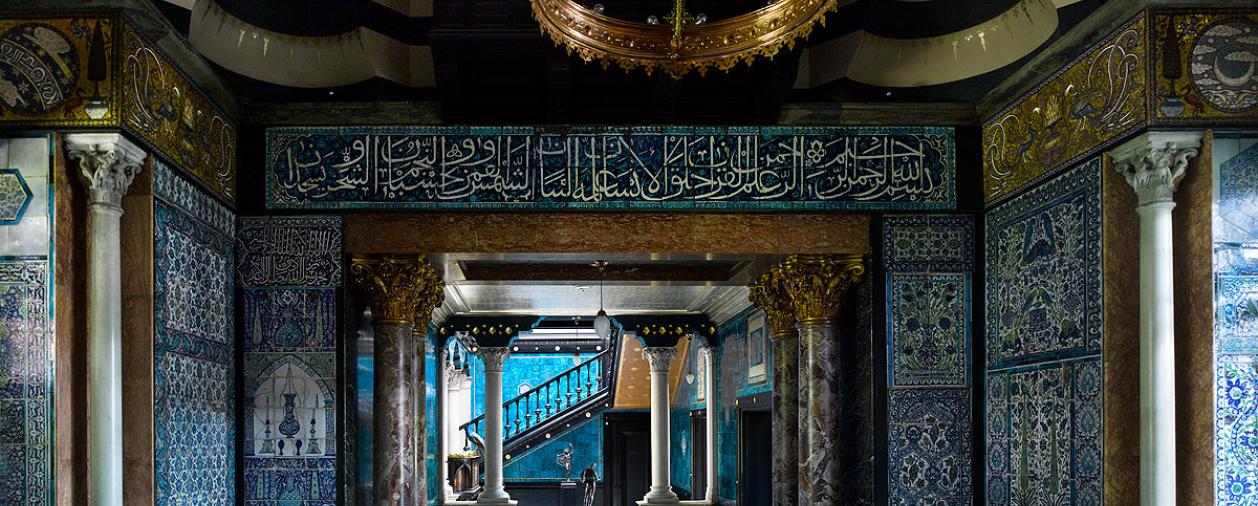
Leighton House provides an exciting and most of all unique place to explore pattern and shape in buildings. There are a huge variety of traditional Islamic patterns alongside Victorian patterns. There are many contrasting shapes, sensations and vistas to be had in the rich variety of design and decoration in the museum. For those not able to organise a visit to the Museum this activity can be undertaken as a joint ICT/Art and Design session by using our online resources.Pupils explore Leighton House (either in person, or virtually), recording and commenting on what they encounter. They then work in groups to decorate their own interior inspired by the Arab Hall. Working in groups they each create one wall each, designing their own patterns.
Aim:
help pupils to understand the
range of patterns used in Islamic art and to use appropriate vocabulary to
describe pattern (eg floral, geometric, symmetrical).
to explore how shapes and
spaces in buildings make you feel.
to create their own interior,
working collaboratively.
Method:
The activity uses exploration (actual or virtual) of Leighton House as a starting point for looking at different patterns and shapes and as inspiration for creating their own collaborative work. Careful recording ensures pupils practice their skills of observation.
Resources:
Leighton and Middle East website:
Virtual tour of Leighton House
Information in 'What is Islamic Art?' article
Websites of the following institutions may also be useful for research and images of Islamic patterns:
Metropolitan Museum, New York
Victoria and Albert Museum, London
The British Museum, London
Materials:
pattern log (provided on website), pencils, stiff card, pens, coloured card (for mosaic work)
Activities:
1) Introductory session looking at what patterns there are in the house. Use the introduction to Islamic art and architecture as background reading, explain to pupils about geometric and floral/vegetal Islamic patterns so that they are able to identify these. Ask pupils to think about how 'realistic' examples floral/vegetal patterns are.2) Visit the museum or go take pupils on a virtual tour as a class.
3) Pupils complete a 'pattern log' where they record four contrasting patterns (you could use the pattern log on this website or create your own). They start by copying them (shape only), then record the colours, where it is used in the building (why?) and what material the pattern has been made with.
4) If visiting the Museum pupils can make rubbings of the floor (ONLY).
5) Ask pupils to contrast the inside and the outside of Leighton House. Encourage them to use feeling words in this exercise.
6) Divide pupils into four groups. Each group has to decorate an interior façade of a square hall, like the Arab Hall (not life size! Just a model). They can do sections individually, or in pairs, agreeing how they fit together. Make sure they think about a door and windows. They can use pens and pencils, collage, mosaic or create repeat patterns/tiles using a computer. There is no need for a roof.
7) When completed fix walls together and place on a firm base. Pupils appraise each others' work and discuss what it might be like to be in this space.
Cross-curricular links:
En1 Speaking and listening (group discussion and interaction)
En2 Reading (if using the Virtual Tour)
Ma3 Shape, space and measures
There is also crossover with some aspects of Design and Technology at KS1 and 2
Investigating Pattern (Unit 3b)
While Leighton House does not have any more of the textiles in Leighton's original collection, many of the tiles at the museum contain motifs and patterns that would also have been found in textiles. These patterns were also an important inspiration for the textiles of the Victorian craftsman William Morris, who founded the Art and Crafts movement. His patterns made for fabrics and wallpapers are still very popular today. This is a starting point for discussing patterns in Islamic art, and the role of textiles generally in different cultural contexts. Pupils use their research as a basis for creating their own piece of textile art.Aim:
For pupils to understand how
geometry, floral designs, animals (and even human figures) can all be
incorporated into pattern.
For pupils to understand how
patterns and textiles have been used in different cultures for different
reasons.
For pupils to use similar
methods to William Morris (stencilling/print-making) to create their own
textile design inspired by the tiles at Leighton House.Method:
The activity uses exploration (actual or virtual) of Leighton House and the work of William Morris as a starting point for looking at different types of patterns as inspiration for creating their own collaborative work.
Resources:
Leighton and Middle East website:
Virtual Tour of Leighton House
'What is Islamic art?'
'Leighton and Collecting art'
Photographs of Leighton House in the nineteenth century showing some of Leighton's collection of textiles in situ.
Website of the following institutions may also be useful for research and images:
The Arts and Crafts Museum, Cheltenham
Materials:
pattern log (download Word document), fabric (calico/hessian), paper, fabric or water-based paint, printing materials (base boards, sponge), if possible computer package with rotate, repeat and edit features, scanner.
Activities:
1) Introductory session looking at what patterns there are in the house. Use the introduction to Islamic art and architecture as background reading, explain to pupils about geometric and floral/vegetal Islamic patterns so that they are able to identify these. Ask pupils to think about how 'realistic' examples floral/vegetal patterns are.2) in groups research how textiles are used traditionally in the following regions of the world: Africa, South America, Europe, the Middle East, Japan and China, India.
3) Visit the museum or go take pupils on a virtual tour as a class.
4) EITHER Pupils complete a 'pattern log' where they record four contrasting patterns (you could use the pattern log on this website or create your own). They start by copying them (shape only), then record the colours, where it is used in the building (why?) and what material the pattern has been made with. OR Pupils play hunt the animal and see (They could do this in groups and discuss/present their findings with the other group)
5) Pupils create their own 'unit' or template for a repeat pattern. They decide shape of unit to be repeated (i.e. square, triangle), then draw pattern and decide on colour.
6) Translate this into a textile either using block printing or stencils
Cross-curricular links:
English: En1 Speaking and listening (group discussion and interaction)
Maths: Ma3 Shape, space and measures
Design and Technolog:y 'Money Containers' (Unit 4A)
ICT: 'Developing images using repeat patterns' (Unit 4B)
Citizenship: 'Living in a Diverse World (Unit 5)
What
we offer:
Costumed actress-led sessions
Storytelling sessions
Visit preparation and follow-up work
Making a booking:
Schools' booking form (download Word document)

Risk Assesment form
(download Word document)

Costumed actress-led sessions
Storytelling sessions
Visit preparation and follow-up workMaking a booking:
Schools' booking form (download Word document)
Risk Assesment form
(download Word document)