The refurbishment of Leighton House Museum
The £1.6m refurbishment project was funded by the Royal
Borough of Kensington and Chelsea. The works involved extensive
repairs to the original fabric of the house as well as the
redecoration of the interiors. A new environmental control system
replaces the 60-year-old central heating system, and the electrical
services throughout the house have been completely re-wired. The
refurbishment has created stable and safe conditions for the
preservation of the house and collection.
The closure of the Museum also provided an opportunity to look
again at the decoration and presentation of the interiors. After
Leighton’s death in 1896, the original decorative schemes of the
house were gradually eroded through the first part of the twentieth
century. Only since the early 1980s has the reinstatement of
Leighton’s original decoration gathered pace and the character of
the interiors have been re-established.
In recent years, a combination of contemporary descriptions,
photographs and scientific analysis have been used to establish the
original décor of Leighton House. The house was often written about
in specialist architectural journals and general press, but these
descriptions were far from definitive and each could be interpreted
to achieve very different results.
In order to take our understanding further, an architectural
paint specialist has been working at the house over recent months.
The science and sophistication of paint analysis has grown
enormously even since the early 1980s when the restoration of the
house began.
The results confirm that the decoration in the house was even
more extraordinary in several important respects. According to the
contemporary articles, the floorboards in the dining room and
drawing room were painted red and blue respectively. No obvious
trace survived, but when the floorboards were lifted, pigment was
still visible where it had run down the side of the board.
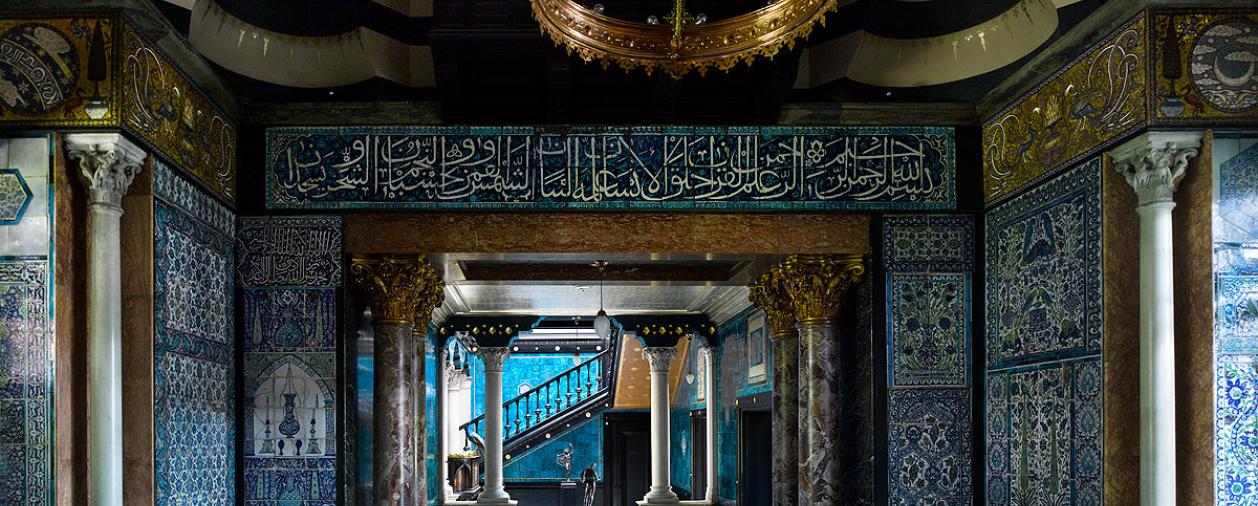
The dome of the Arab Hall was gilded; the original floorboards
on the first floor survive beneath modern flooring laid over them
in the 1960s. These features have been restored to bring the house
closer to how it was when Leighton died in 1896.
A number of specialist manufacturers were commissioned to
recreate the wall coverings in the Silk Room and Dining Room, as
well as the soft furnishings throughout the house. Original
architectural features, like fire places removed in the twentieth
century have been put back.
Design team
Architect Purcell Miller Tritton
Electrical and Mechanical Engineers Harley
Haddow
Quantity Surveyors Sawyer and Fisher
Structural Engineers The Morton Partnership
Lighting Designer Sutton Vane Associates
Contractors
Main Contractor Coniston Ltd
Electrical McGoff & Vickers Ltd
Mechanical Working Environments Ltd
Decorators Angel Interiors (UK) Ltd