Atlas of An Entangled Gaze by Ramzi Mallat
A new commission presented as part of the exhibition The Arab Hall: Past and Present, and on show until 13 May 2026.
Atlas of An Entangled Gaze is a site-specific installation by multidisciplinary artist Ramzi Mallat commissioned for the Arab Hall at Leighton House. Composed of over 7,500 glazed ceramic charms, the work is suspended from the Hall’s central gasolier, forming a vast, cascading canopy of interlinked luminous blue ‘evil eyes’, connected through chainmail-like techniques inspired by medieval Ottoman helmets.
Atlas of An Entangled Gaze by Ramzi Mallat. Image courtesy of Jaron James.
The evil eye: protection or malevolence?
Drawing on one of the oldest known apotropaic symbols, which can be traced to the Assyrian Empire (in present-day Iraq and parts of Syria), the ‘evil eye’ embodies a duality of protection and malevolence. Reimagined at monumental scale at Leighton House’s Arab Hall, the motif becomes both talisman and intervention: a field of vision that simultaneously shields and exposes.
I was interested in the evil eye as something deeply embedded in everyday life across the region, not just as an object, but as a belief system tied to protection, envy, and vulnerability.
Atlas of An Entangled Gaze by Ramzi Mallat. Images Jaron James and Ramzi Mallat.
The evil eye glazed ceramic charms featured in Mallat’s installation were manufactured in multiple factories across Turkey, and then individually cleaned and treated in the artist’s studio, allowing for the maker’s mark to reappear in mass produced items.
Ottoman helmets and Islamic art traditions
Forming a canopy of watchful eyes, cascading from the central gasolier, which is part of the original Hall’s décor – Ramzi’s deliberately mirrored the structure and techniques of medieval Ottoman helmets, which are in themselves a form of protection, as well as being associated with conflict.
In dialogue with the Arab Hall’s Damascus tiles, mosaics, and domed ceiling, the installation echoes the geometry of Islamic ornament and the filtering structures of mashrabiya screens.
Power dynamics and the gaze
Atlas of An Entangled Gaze reexamines the subtle power dynamics embedded in the Arab Hall — who is looking, who is being looked at, and how cultural symbols travel and transform. The work gives a space that is constantly being gazed at, the agency to look back.
In focusing on the idea of the gaze, the piece also references the neighbouring Narcissus Hall, and the myth of Narcissus, a youth so captivated by his own reflection that it led to his downfall.
The gaze is central to the negotiation between Western and Eastern traditions, and how narratives are controlled and articulated. This work asks the viewer to consider when does appropriation express admiration and when does it become an act of violence.
Atlas of An Entangled Gaze by Ramzi Mallat. Image courtesy of Jaron James.
Meet Ramzi Mallat
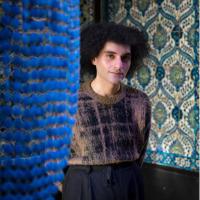
Ramzi Mallat is a multidisciplinary artist based between London and Beirut. His practice explores cultural identity through Levantine folklore, material culture, and collective memory. By reinterpreting heritage, symbols and artifacts, Mallat examines how they persist, shift, and are reimagined across geographies and time.
He holds a BA from Lancaster University and an MA in Sculpture from the Royal College of Art, London, and currently serves as a trustee of the IMOS Foundation (UK). He was featured in Forbes Middle East’s "30 Under 30" list (2022) and shortlisted for Bloomberg New Contemporaries (2024).
Mallat’s work has been presented in solo exhibitions at the Victoria and Albert Museum (2025), Project Loop (2025), Marie Jose Gallery (2024) and P21 Gallery (2023), in London, and at Takeover (2025), Cervantes Institute (2018) and the UNESCO Palace (2017) in Beirut. His work has also been featured in group exhibitions across the United Kingdom and Europe, including at the VIMA Art Fair (2025), Turf Projects (2023), Standpoint Gallery (2022), Candid Arts (2022), and the Storey Gallery (2017).
Plan Your Visit
Ramzi Mallat's Atlas of An Entangled Gaze is on display from 21 March - 13 May 2026, a new commission presented as part of the multidisciplinary project The Arab Hall: Past and Present (21 March - 4 October 2026).
Included in Leighton House admission tickets.