
When The Tiles Spoke, by Soudade Kaadan
What happens when the creations of one world are lifted from their roots and set into foreign walls?
Director's Note, by Soudade Kaadan
From the outside, Leighton House looked ordinary. A modest brick façade, like many others in London. Nothing announcing what it holds inside. And then, once you pass the reception, his desk room, the door to the hall — there it was. The Arab Hall. A hidden Damascene qa'a style interior, with blue tiles and mosaics. A fountain at its centre.
It felt like entering a Damascene home. In Damascus, houses do not reveal themselves easily. The exterior is humble, a wall turned to the street, a face that gives nothing away. You discover them only when granted a personal invitation. You pass through a small wooden door, unremarkable from outside. And once you get in, head down because the door is low, only then the world inside opens. Water. Bitter orange trees and jasmine. The extravagant façade is not in our culture. I saw this in Leighton House. This same logic. This same restraint giving way to wonder.
The Arab Hall with the fountain in the centre of the room.
I was moved to find those tiles here, this small oasis of tranquility in the middle of London. For a moment, I felt I was not so far from home. When the museum invited me to make a film as part of The Arab Hall: Past and Present, marking one hundred years since the house became a museum, those feelings returned immediately. But so did the questions.
I first visited Leighton House in 2023. At that time, I was not allowed to return to Syria. The mukhabarat, Syria's secret police, had warned my family that I should not come back. Not even think about it. The feeling that I might never see my city again, old Damascus, was heart-breaking. I felt uprooted, like a tree.
Leighton House sits at the centre of a debate that tends to resolve the Arab Hall into one of two things: an act of love, or an act of appropriation and orientalism. Both positions have truth in them. My film sits in the discomfort of both, without resolving either — letting the tiles themselves ask the question, and giving them the voice and agency to do so. These tiles had made a journey they did not choose. They too had been lifted from their place, carried across distances, set into walls far from where they began. I was also here, in London, carrying a world inside me that I could not return to. The film was born from that recognition. Not from the outside looking in, but from the inside, looking back.
Animated tile panel featured in When the Tiles Spoke
I shot most of the night sequences in extreme close-up, with macro lenses, because that was the only way to give the story back to who is actually holding it. I avoided the wide, sweeping shots of the space because I was afraid the general shot might adopt the orientalist frame. Instead I went into the details of the tiles: the artistic beauty, the craft, the marks of time. That shift in scale is also a shift in power. It moves the gaze from the collector, to the tiles themselves.
The film is a hybrid fiction with documentary because memory itself is not linear. It moves between fact and longing, between history and dream. Because exile itself feels like that — a constant negotiation between what is real and what is remembered. This film is born from that in-between state. A conversation between London and Damascus. Between preservation and displacement. Between past and present.
Filming in progress at Leighton House
Until now, when we speak about the Arab Hall, the main image is of the hall itself. It is only once watching the film that you can see it in close-up, and begin to appreciate what the craftsmen from Damascus and the surrounding regions tried to reflect and say, culturally, politically, about their times. Most of those who watched the film went back to the room afterwards and tried to find the characters, and could not find them all. We are so used to giving an object a fast glance in a museum and moving on. This film asked viewers to slow down and see differently. It forced a different perception and relationship to the space.
Museums often freeze artefacts into aesthetic silence, and when they give a voice to objects, it is usually through a guided tour or an audio set talking about dates and history. It is the institution speaking on behalf of the object. In this film the tiles are the protagonists — they have their own voice, intimate and particular, free to imagine what they would say during the night when everyone has left. It mattered to me that the cast were Arab actors based in the UK, bringing their own accents, their own cultural memory, their own relationship to a heritage that is entirely theirs.
Tile voices recording with Khalid Abdalla, Souad Faress and Leem Lubany.
A month ago, I finally returned to Damascus, after 14 years of forced absence. Walking through the old city, I found myself drawn to the tiles and mosaics differently. Looking more closely at the craft, the patterns, the fragments. The film had given me a new attentiveness to what they hold.
Soudade Kaadan
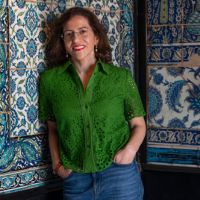
Soudade Kaadan is a Sundance and Venice award-winning Syrian filmmaker born in Paris, raised in Damascus, and based in London. She gained international recognition with her debut feature, The Day I Lost My Shadow, which premiered at the Venice Film Festival in 2018 and was awarded the prestigious Lion of the Future for Best Debut Film. This marked the first time a Syrian fiction film competed in Venice. Her short fiction film Aziza won the Grand Jury Prize at Sundance in 2019 among several other accolades. Her second feature, Nezouh, won the Audience Award at Venice in 2022 and was released in cinemas across the UK, Italy, France, Switzerland, and the MENA region. All her fiction films have been released on Netflix. With a multidisciplinary background in French Literature, Theatre, and Cinema, Soudade brings a unique formalist perspective to her work.
Cast
Khalid Abdalla
Souad Faress
Leem Lubany
Sara Masry
Sami Abu Wardeh
Crew
Writer director, editor and producer: Soudade Kaadan
Director of Photography: Nick Cooke
Animation producer: Ayse Unal
Colorist: Jateen Patel
Sound designer: Andrej Bako
Music composer: Rob Manning.
Line producer: Midnight Adams
Voice casting director: Daniel Jewel
Plan your Visit
When the Tiles Spoke, a short film by Soudade Kaadan (13 min)
From 21 March to 4 October 2026 in the Verey Exhibition Gallery at Leighton House.
As part of the exhibition, The Arab Hall: Past and Present
Included with admission ticket
Acknowledgments
When the Tiles Spoke by Soudade Kaadan has been commissioned by Leighton House with the support of the DCH Foundation, the museum's Exhibition Circle and The Friends of Leighton House. The promotion and outreach for the programming of 100 Years of Leighton House has been supported by the CORA Foundation.